Earlier today I visited a client of my web site business in Lower Manhattan. Their office is a few blocks walk north of the World Trade Center.
Few New Yorkers, other than media types and those peddling goulish day tours, refer to “ground zero.” Like many others born and raised in Jersey City, I hold self-appointed dual citizenship in NYC. We New Yorkers stubbornly call it the World Trade Center, partly out of memory but largely out of defiance and a refusal to allow the 9/11 scum to think they took away anything more than the physical.
click to enlarge
It’s another insight into local character that, until that day, both the World Trade Center and Mayor Rudy Giuliani, were seriously disliked and even reviled, by most New Yorkers; one for ugliness, the other for arrogance (you figure out which is which; could be either or both). But once something of our own is attacked by “outsiders,” it immediately becomes beloved. Well . . . maybe that’s too strong a word; try “tolerated.”
For all of New York’s alleged modernity, we do not easily abandon place names. We require a little time before we accept a name change. That may explain why Sixth Avenue, whose name was changed only 64 years ago to Avenue of the Americas, is still Sixth Avenue on local maps. The West Side area between 23rd and 42nd streets that real estate developers want to call “Clinton” remains “Hell’s Kitchen” to the rest of us.
It was no surprise that bureaucratic post-9/11 attempts to change the World Trade Center PATH Station name to something else met with cries of outrage in the distinctive local accent.
This morning, as usual, when the PATH train from Jersey City pulled into the open wound known as “the washtub,” the deep space at the foot of the former towers, I averted my eyes. I can never look.
The one time I did that, in 2003, on my first visit since 2001, as I stepped from the train to the platform, I was clobbered as if by Gorgon’s Gaze of mythology.
It’s widely agreed that the most important foreign-language question for travelers is, “Where’s the nearest bathroom?” Having read of Delhi Belly and the Mumbai Trots, I want to be perfect in my annunciation of this need, and even more important, be able to understand the answer.
One of my reasons for choosing this route to Sydney instead of the more obvious one across the USA and over the Pacific Ocean using a United or Qantas Boeing 747 is that Malaysia Airline uses a Boeing 777.
The center rear rows on the Malaysia Boeing 777 are five seats across. (Seat Guru) In most of those rows (but not all) the armrests can be raised to create a bed-like space roughly 8 feet long. It’s a bit narrow for a guy my size but still sleepable. I’ve yet to see a Malaysia Air 777 on these 7 to 10 hour flights anywhere near pax capacity. However, whenever I inquire at checkin about the flight load, I invariably have been told that the flight will be “full or almost full.” I think that statement reflects a capacity definition that requires them to fly with empty seats because the aircraft’s fuel capacity will not allow it to fly that distance whilst carrying a pax in every seat.
But the 747, with much greater fuel storage, can carry full pax load. So, assuming the ability of the airline to sell – and assuming the demand – empty rows on a 747 in this kind of service are less likely than they are in a 777.
It should be interesting to how this works out on the flights during this itinerary.
UPDATE POST TRAVEL: I have yet to see a 777 fly these long segments with a full pax load.
The Stockholm Syndrome is famous among pyschologists and sociologists. It refers to the intruiging concept, based on a prolonged bank robbery during which the hostages protected their captors when the police attempted a raid. Psychologists say that hostages often form sympathetic bonds with their captors as a survival mechanism. Survivors of an extended ordeal sometimes need to be deprogrammed back to the reality that they have been abused.
International air passengers at Stockholm’s Arlanda Airport may well need some shrink-service.
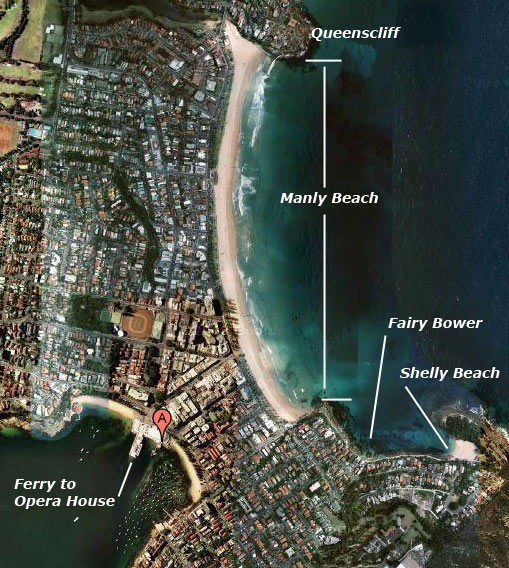
My first day back visiting beloved Australia started just after dawn in Manly with a brisk walk north along the beach, from the Gazebo near the Corso, about a mile to Queenscliff and back. If the Gazebo looks familiar to Americans, it was the centerpiece in a television commercial for Old Navy clothes, shown frequently across the US in August Prime Time. Teenage dancers were romping around the Gazebo, showing off the Old Navy fashions.
The Fujitsu Lifebook P7120 laptop computer is out of service and the situation is not good. Only a few months ago I paid $2,000 for it and invested roughly $1,000 more in software and memory upgrade. Now its only dependable function is to keep loose papers from blowing away in a breeze.
Turning and turning in the widening gyre
The falcon cannot hear the falconer;
Things fall apart; the centre cannot hold;
W. B. Yeats, poem
As usual, I’m clueless about what, if anything can be done to salvage the relationship with “E.” She’s totally withdrawn. I’m in the spare bedroom (says she can’t sleep with me in the same bed). Won’t talk (“nothing to talk about”). Goes off on her own for hours (“I need to be alone.”).
The 29th Manly Jazz festival opened today. Despite a great deal of anxiety about the incomplete condition of the Corso reconstruction, everyone seemed satisfied. My son, John Harkins, was the afternoon’s attraction on the Main Stage overlooking Manly’s mile and one-half long beach.
I’ve never heard John play with such fire. His runs were awesome and his improvisations full of joy and excitement. I’m sure the crowd’s response added to his enthusiasm. (Click on the “read more” links for photos)


 I’ve yet to see a Malaysia Air 777 on these 7 to 10 hour flights anywhere near pax capacity. However, whenever I inquire at checkin about the flight load, I invariably have been told that the flight will be “full or almost full.” I think that statement reflects a capacity definition that requires them to fly with empty seats because the aircraft’s fuel capacity will not allow it to fly that distance whilst carrying a pax in every seat.